

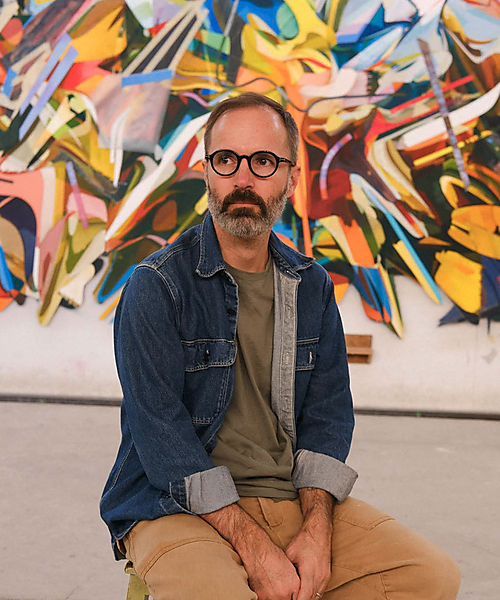
I am a painter working within abstraction.
I treat the surface as a register of actions. Oil, colored pencil, ink and acrylic are incised and layered into linen until the accumulated marks hover at the threshold of legibility — never resolving into an image, never dissolving into nothing. What remains is evidence: a record of decisions made, revised, and left visible.
Painting is a frame of reference that modulates experience. Its history — gesture, color, figure, form, space, composition — is not exhausted but available: an index of visual phonemes from which the work is assembled. I am interested in what those elements can still be made to do.
Abstraction matters because it refuses translation. In a culture that expects every act to be interpretable, a painting that cannot be paraphrased returns something to the person standing in front of it — the right to a reading that is theirs. The work is not an image, which stays still, but a duration, which changes.
I think of each painting as a Trojan Horse. An offering that unfolds, and keeps unfolding, in the mind.